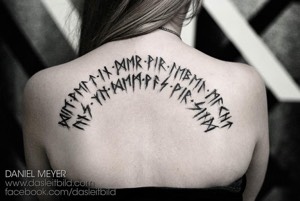
 What would you feel if you saw a guy with a runic tattoo? Many would probably feel uneasiness, including myself. The question is why. I perfectly know that ancient Germanic peoples used the Elder Futhark not because they were white supremacists. I realize that vikings used the Younger Futhark not because they were racist skinheads. So where comes the uneasiness from? Let’s take another example. If you use the Bluetooth technology on your mobile phone, you should remember their logo. Do you? It is actually a bindrune, that is two blended runes: Hagall (hail) and Bjarkan (birch). These two represent the initials of the 10th century viking king Harald Blåtand (Bluetooth), who ordered the Jelling stones to be erected. Bluetooth team are certainly not a hate group, and their rune logo does not scare people away from buying their technology. However, tattooed on someone’s shoulder, it may make others feel uneasy. The question remains: why? My answer is: because western civilization has been too long obsessed by Classical Antiquity as its treasured source. All we usually know about Norse or ancient Germanic symbols is that nazis used them and neo-nazis still use them. That’s not a lot. The other answer is: many people with Christian background still feel that heathen convictions may be dangerous, especially if associated with Norse or Scandinavian culture (or with anything ancient Germanic). Even atheists have been educated in schools long dominated by Christians who admired Classical Antiquity. “Virgil and Homer, not Edda and Beowulf” has been their slogan for many centuries.
True, Norse heathen symbols were used by Nazis. For instance, the Hagall rune used in the Bluetooth logo is present on the SS Totenkopfring. In his description of the ring, Himmler wrote: “The swastika and the Hagall-Rune represent our unshakable faith in the ultimate victory of our philosophy.” This rune was also used during the SS wedding ceremonies. Does it mean that the Hagall rune is in itself a hate symbol? No way.
The origins and the cultural meaning of Norse symbols or Germanic heathen symbols, which may point to racism in certain contexts, are treated in a series of articles on this web site:
Photo © Daniel Meyer. Used by permission.





The Nazi that created the symbolism for banners, flags, uniforms, posters used anything that looked powerful in order to make them look dominant. This is a common tactic used by every extreme government. The traditional swastika itself was used to help solidify allegiance with the Japanese and to make it seem that the party was peaceful, but the traditional symbol has nothing to do with Nazism and was used by many cultures that never interacted with one another. It was even the symbol of a US car maker prior WW2.
The Nazi’s were just thieves of symbols from various cultures. There’s no reason to fear any Norse or ancient Germanic symbol because it was/is misrepresented.
I am registered under a dozen gangs in California. Never been in a gang. But I have a Rune tattoo.
I have actually been in a few fights and an almost lethal one at that for my Rune tattoos and religious beliefs as a heathen/odinist…
Here in Indiana(United states) it’s one of the few states where “asatrue” is actually organized in the prison/jail system. The white supremacists and aryan brotherhood use it as a cover and a front for their hate and because it’s usually viewed as a “white only” religion they hide behind it…
I have not only a clover and Triquetra tattoos(white supremacy prison symbols) as well as several runes and blonde hair blue eyes giant red beard… I was approached repeatedly and had threats that they would remove my ink if I didnt joint them seeing as I had the right looks and right tats… right “religion” ended up having to fight daily and weekly till finally they got the message that I was neither joining or removing/covering my tattoos…
To this day I still show off the stab wound scar I earned defending my beliefs, morals, and tattoos every time someone calls me a nazi.
I could have very easy allowed myself to fall in line with them but instead I protested, fought, and verbally spoke out against them the whole time.
I was told I was ignorant and risking my life… but I figured out quickly they’re all scared and usually do a horrid job of proving superior as one guy single handedly kept them at bay and spoke against them and how they dont represent the majority of us heathens they only Make up a 5th roughly and they dont even understand the meanings or faith behind it. They mix it with their “1488 and lighting bolts and panzer tank tats” and smuggle meth…
I showed that even someone who fits the perfect idea of their master race could use MY faith and my solitude to divert and expose them every time I got the chance!
This is my bloodline, my heritage and my lifestyle and I HATE(dont use that word much) nazis and racial radicalism as it does nothing but show ignorance and make the world a darker place.
NAZI’S act like they’re heathens.
But they wouldnt know the first thing about Odin, tyr, freya, or thor and their blessings or anything except how to use racial slurs sell drugs
Thank you for sharing this, Timothy.
Hey that’s crazy you had to fight weekly and then monthly against the Aryan brotherhood of terra hut Indiana federal prison to defend your whatever…. no you didn’t if ab called for you then ab got you period. Your not being real about this. Ab has several sets but all are organized. Asatru def could be a front for white supremacist gangs but most are not racist at all rather they are proud to be vikings and prefer to be with there own and are greatful to be able to practice there ancestors faith in ancient times all the way to today
Hei guys! I’am from Czech rep. I’m a punk and I love Vikings and whole Scandinavia. But runes as a tattoo there? I’m a “nazi punk” then… People are weird/stupid and it’s so sad. However.. I still love all these things.. I don’t care. :-) This web site is awesome. Thanks! SKÅL!
I’m Jewish and think runes are lovely. In fact, they remind me of old Hebrew. Wear those runes and shave your head and be pagan with pride! The Nazis lost, woo-hoo!
That’s the spirit! And right attitude ;p Woo-Hoo LOL
I am of scandinavian norse decent and i will say that ive been called a Nazi because i shave my head. Well i dont shave my head in support of the nazi clucks but i am balding and have been since 16 which i started to receed so i shave my head. I wear symbols of the gods in honor of them i also wear bindrunes and have a couple tattooed. But i dont have them as symbols of hate.
Hi!
Great Article!
Im a Norwegian and im very proud of the scandinavian Viking heritage!
Im VERY SAD when I see some Nazi idiots are using the signs! Screw then and the soilders of odin morons!
Im happy to use theese signs are argument against the nazis and inform and tell others that this is not nazi signs.
Thank you for sharing this, Ivar.
I am also of Nordic ancestry and heritage, I hate how the stupid Nazi’s ruined my culture and history by creating so much hate towards runes. They had no right to take runes that had a good meaning and remake them into symbols of hate.
I believe most of these rune symbols were used solely because the nazis had a over wellming belief in the occult so any symbol dealing with the occult was used my entire head is covered in Norse tattoos but I am a believer in the Norse paganism so screw the nazis
I’m a non-bigoted Norse Pagan as well. Hail, brother!