
 In September 2008 Dr James H. Barrett, who is deputy director of Cambridge University’s McDonald Institute for Archaeological Research, published a paper that provoked lively discussion. The paper was entitled “What caused the Viking Age?”. It was published in Antiquity v.82 n.317, pages 671-685 (available for subscribers here). The Viking Age began dramatically in 793, when Norsemen ransacked and destroyed the abbey of Lindisfarne. Very soon Europe fully realized why Jordanes, Gothic historian of the 6th century, wrote that Scandinavia was officina gentium (“the source of races”): large bands of Vikings moved from their native lands in hopes of acquiring wealth.
Clerics and lay people prayed throughout Christian lands looted by Vikings: Domine, libera nos a furore normannorum (“Lord, save us from the rage of the Nordic people”). Ever since shocked Europeans have been wondering, why it all happened, why Norse warlords poured out of Scandinavia in the 8th century.
Dr Barrett reviewed the main suggested causes that are usually advanced to explain the beginning of the Viking expansion, and dismissed them. For instance, the development of the Viking longship cannot be the reason of the Viking Age. It is a pre-requisite, but not a trigger. Moreover, sailing time from Norway to Ireland is rather short, and Norsemen were able to raid Ireland much earlier than in the 8th century. Actually, an earlier migration from Scandinavia to Britain took place in the 5th and 6th centuries, which did not lead to devastating effects of the Viking Age. According to Dr Barrett, other reasons, like climate change, overpopulation and the state of economy in Scandinavian lands are no better. The point of Dr Barrett’s research is that the true cause was selective female infanticide.
Killing of female newborns practiced by Vikings might well lead to shortage of Scandinavian women eligible for marriage. Intense competition among male warriors forced them to leave Scandinavia to find wives and establish their own households. It is interesting that much of the plundered bounty, particularly from British monasteries, was found in the graves of Viking wives. Dr Barrett adds that the other reason was the Norse idea of honor and religious fatalism of the Vikings. However, the researcher has to admit that Vikings still “highly valued” women, despite the female infanticide. The sumptuous burial in the Oseberg ship is in fact a rich grave of two Viking women.
There is hardly only one straightforward answer to the Viking question. Nevertheless, Dr Barrett’s research surely adds to our understanding of the Viking Age triggers.
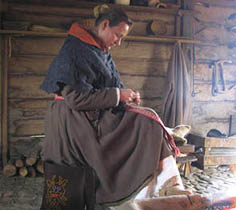
Photo courtesy hans s. Used under the Creative Commons Attribution-No Derivative Works 2.0 Generic Licence.





Pretty poor research. The Viking expansion into what is now Scotland started in the 7th century according to datable archaeological evidence found in the Shetland Islands. The so-called (and oft-used) ‘quote’ about the fury of the Norsemen is a 1960’s invention, no such actual quotation has been found in the writings of the time, though there certainly were warnings about the Norse! Where is the evidence of female infanticide? Sources and provenance are required for this, otherwise it’s merely uninformed speculation.
Nick, you are right to point that the phrase ‘Domine, libera nos a furore normannorum’ does not occur in the actual Carolingian texts. However, a very similar prayer to ward against Vikings is found on fol. 24 of the Antiphonary of Charles the Bald (ca. 870) and it’s pretty similar in its content:
Summa pia gratia nostra conservando corpora et custodita, de gente fera Normannica nos libera, quæ nostra vastat, Deus, regna.
Pity [us] the highest favor by preserving and guarding our bodies, free us from the savage Norman tribe who devastates our realms.
Yes, Viking expansion started earlier, so what? Lindisfarne is just a traditional beginning of the so called Viking Age. Large scale attacks followed this event.
For female infanticide see: Selective Female Infanticide as Partial Explanation for the Dearth of Women in Viking Age Scandinavia,” pp. 205-221 in Violence and Society in the Early Medieval West, edited by Guy Halsall. Woodbridge, United Kingdom: Boydell Press, 1998.
But why does Dr. Barrett assume that there was a lot of female infanticide? Where is the evidence for it? The Vikings were a good bit more egalitarian than most people in Europe at the time; why should they undervalue female children? Much of Viking history, literature and mythology shows much the opposite: that a Viking warrior usually had a wife back home to take care of the homestead — which also involved fighting off any bandits who tried to raid the livestock — while he was off a-viking.
Could it be that there’s a more psychological reason for the sudden flood of Viking raids into Europe? Is it only coincidence that this was also the period when Christianity was spreading through Europe? Could it be that the Pagan Vikings were offended by Christian missionaries showing contempt for the Pagan deities, and set out to punish the offenders? Could it be that the Vikings saw Christianity as weakening more southerly Europeans, and couldn’t resist easy prey? Or did they notice that monasteries and convents were full of non-combatants who collected substantial treasuries, and couldn’t resist easy pickings? Given the nature of Viking society, any of these are more likely reasons than female infanticide.
–Leslie <
I remember once reading that the prohibition on Christians trading with non-christians came about right around the same time as the begining of the viking age.
Perhaps Scandinavians, long used to trading with people further south, decided to use more extreme methods to get goods when their pagan money was no longer good enough?
Har det bra,
Leif
I haven’t heard of tieing the legs, but the arms were bound together to symbolise the bond.
Hello, I was trying to figure out if Viking marriage rituals consisted of the bride and grooms’ legs being tied together?
Thank you