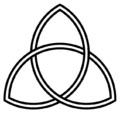
 Triquetra is a Norse Viking symbol closely connected with the Valknut and Horn Triskelion. Artifacts with Triquetra ornaments are found in all parts of the Viking world, ranging from the comb found in Gnezdovo (near Suzdal, Russia) to the saddle bow from Coppergate (York, England). In Latin triquetra means ‘triangular’ (feminine singular). Initially this word designated any three-cornered figures, but now it is applied to the shape formed by three interlocked semicircles at the place where three circles would overlap. These form three interlocking vesicae piscis (Latin for ‘bladders of the fish’), also called mandorla (Italian for ‘almond’, plural mandorle).
Heathen Triquetra ornaments may be simple (above to the left) or rather intricate (as on the Funbo runestones, Uppland, Sweden, above to the right). The symbolism of the Norse Triquetra is almost certainly related to some heathen religious concepts. However, what exactly it meant to Vikings is difficult to ascertain since at a very early stage Triquetra was also used by Christians to convey their own religious content. For instance, the Triquetra that was struck on the coins by the Christian Norse kings of York most probably was already reinterpreted by York Vikings in the Christian perspective. The same may apply to the silver penny issued by Harald Hardrade (king of Norway from 1047 to 1066).
For Christians the Triquetra might point to the Trinity: such a use was probably facilitated by the three elements of the Triquetra, which resemble fish, ancient Christian symbol (ΙΧΘΥΣ). In modern popular culture the Triquetra often points to Norse or Celtic paganism. It also appeared on the cover of the “Book of Shadows” in the TV show Charmed with Alyssa Milano. The Triquetra, sometimes combined with the circle, is often used in Norse or heathen tattoo designs.





To have only a “sorry no this southern empire said otherwise so you dont get to name your own people or speak of your history, only wikipedia” response, to people protesting this representation of their history, is an inadequate response at best.
I think the issue taken with the terminology “germanic” in general, for most Scandinavians is the fact that this is an example of imperialist history. What did these tribes call themselves? yes gier is spear, but that is not pronounced like gerrrr, the wikipedia page doesn’t necessarily corroborate the perspective offered. As it responds to norse people annoyed at the name, with evidence that the name was assigned by outside parties. This issue is seen for example with the use of the word Korea, instead of Hangul, the name they call their own home.
I just wanted to really say thank you for all the very interesting information I’ve been able to find on this website. I’ve been wanting to get a tattoo involving a triquetra to represent my Celtic roots and thought of getting something Nordic. I was quite pleased to learn that the triquetra is fairly prominent in more than just Celtic history. Great website!
Thank you, Destiny. I am glad this article proved to be helpful.
Stumbled across this site doing research into my family history. I’m from Australia but my family is of Norwegian origin. My bestefar used to tell us folk tales as kids. That started my interest in norse mythology and getting an understanding of where all this came from. I’ve found much wisdom in the texts from old. Proud to be from a family that I’ve traced back to have been in Norway for hundreds and probably more years. Abd on my mother’s side there is a full family tree that goes back to the Viking invaders of Normandy. I wonder if an ancestor of mine knew Rollo?
Anyway, from my perspective there is much shared history between German tribes and Northern tribes. And the term Germanic really encompasses this link. But I guess I’m modern times the term Scandinavian is more appropriate.
Hello David. Scandinavian, as a linguistic and cultural term, is more or less equivalent to North Germanic.
While I (as a born and raised dane for whatever thats worth) can only admit to GierolfHvitrserkers correct definition of Germantic, I too have to side with GregorSven in his statement.
It is 2014 and as always, language evolves with time and culture. Unfortunately, with todays lack of knowledge in the masses, the “new” picture most envision, when they hear Germantic or Germanic is in fact “of Germany”.
How wrong this may be, suddenly becomes irrelevant, when the definition eeeeeverybody else gives it; is a new one.
Hence, knowing that the “rest of the world” defines that term as ” from Germany ” …. i too now MUCH prefer the term ” Men of the North” or Northmen , Norman even ive seen written all over the place the incorrect version Nordmen (funny thing is, I still “feel” that more today than anything with german in it).
History is history as is, undisputable (until proven otherwise) , but current definition in spoken language, is where the matter is for me: ” To be understood correctly, today.”
Since i gave in decades ago, trying to instruct people what germantic truely is and realizing; how much i was a bore, by doing so and how far i did not go with it and how many cocktail parties i´ve put to sleep with those talks….. I have simply chosen to say : ” No, not germanic, Dani, Norman, Skandinavian or when drunk: Viking …as long as i am SURE i am not being, in any way or form, related to todays interpretation of germany, in theyre minds.
Sorry for waisting your braincells, but i had to let this one out.
….also its funny how this simple example, shows how the understanding of single word can change in time and is still changing with time and culture (don´t laugh at me calling lack of knowledge culture, because to our dismay, thats just what it is most times).
p.s. after all, i was raised thinking Hamburger was a person from the city Hamburg, not the sandwich Louis Lassen made in the 1900s .
” No 2014, I´m NOT German …..dammit!”
Thank you for sharing this, Allan. I think meanings of terms should not depend on how people tend to understand them.
Yes! AGREED!
If you’re going to study actual history and language, why not use the actual technical terms? If you want terms that suit the masses, then go listen to pop music or something.
First, I would like to say that this was another good read. thanks for sharing
Second: to Gregor-Sven, while you may be fairly accurate when speaking of modern “german” people, the phrase Germantic, does not actually refer to the germans. It refers to the original use of “german people” which translates roughly into “men of the north” and encompassed the goths, the franks, the germans, the teutonin, the Svear, the norse, etc. Which all of them do have a very common linguistic ancestry within “proto-germanic”. its like spanish and french, while their roots are the same, if you speak french to someone from spain, they will just look at you funny if they do not fully know french.
Hello Gierolf. Thanks for your comment. While I agree with what you write, I’d rather add that the etymology of the word Germani (in this form it first appeared in Latin) is not clear. There are two theories that say it was a Celtic word meaning either ‘neighbors’ or ‘noisy’. Others believe it was a Germanic word meaning ‘spear men’.
Please, I whish to point out a mistake made in history of Skandinavian people. We are labled as “Germanic” this is wrong to classify us in this manner. A German, or Teutonin would have been hard pressed to easily understand the language of a Goth, Svear, Vandal or Norse, as these are the forfathers of modern Skandinavians. It would be like Calling American English speakers Dutch, while the languages are simular, they still are different. My Bestefar(Grandfather) still bangs about in the Great Hall when he hears his Norse people being called “Germanic” this is just not so. What you call Scandinavians are far older than the Germans, our language, and customs simularity came from German contact, trade, and warfare with my Ancestors.
Mangen Tack(Many thanks)
Mangen,
I appreciate your comment. I am Skandinavian as well and not from a ‘germanic’ tribe. I hate to be referenced as such.
The Scandinavians are the Northern Branch of the Germanic peoples. And the Goths are not the forefathers of Scandinavians. They were the Eastern Branch of the Germanic peoples and their language is now extinct. So yes, you are Germanic. And no, you aren’t older than Germans. The Northern Branch is equally descended from the proto-Germanics as the Eastern and Western Branches. Germanic does not mean German.
Germanic Peoples
To say that Scandinavians are older than Germans makes about as much sense as saying Scandinavians are older than Norwegians. Technically true, because Scandinavian peoples existed before either of those countries, but irrelevant. Germanic people originated in central western Europe and were named by the Romans. Scandinavians are Germanic people (not Germans) who migrated north, as opposed to the Finno-Ugric people who are Uralic and migrated to a similar area from the east. The Anglo-Saxons and Franks were also Germanic peoples who travelled west and south respectively, but today they are English and French, not German. So, yes, Scandinavians are Germanic. No one is calling them German.