
 Oseberg ship was found in a large burial mound in 1904 near Oseberg farm, Vestfold county, Norway. It is believed to be one of the best preserved and most exciting Viking ship finds, even though the burial (dating to 834 AD) was looted as early as in the Middle Ages. The ship’s prow and the roof of the burial chamber were hacked through, skeletal remains of two women were scattered, all precious metal objects stolen. However, Oseberg burial yielded wealth of grave goods that were deemed worthless by the thieves but are indeed priceless for the Viking Age archeology.
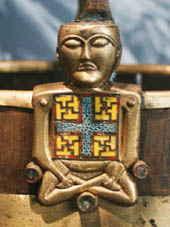
One of the most interesting Oseberg discoveries is the so-called Buddha-bøtte or Buddha bucket. It is a pail with two identical figures forming the joints of the pail handle. Both figures represent a man seated in the Lotus position. His head is flat. His face with closed eyes has a peaceful and sunken expression. The man’s breast is ornamented with red and yellow champlevé enamel as well as panels of millefiori. Four swastikas on the enamel decoration have the shape common in the Buddhist tradition, in which this symbol represents auspiciousness and good fortune.
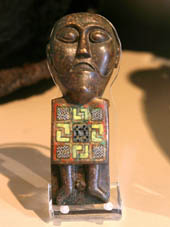 Vikings could in fact meet Buddhist missionaries during their expeditions. Sixth-century Buddha statuette from northern India was found on the island of Helgö, Sweden (currently on display in the Swedish Museum of National Antiquities in Stockholm). However, Oseberg Buddha does not seem to have been imported from Asia. Researchers point to either Ireland or England as possible places of origin. Hexham bucket decoration represents a flat human head with the same type of broad face and the same stress on the eyes. Among other parallels, hanging bowl found at Löland, Norway (Oslo Museum), and the one found in the Maas, Holland (Leiden Museum), could be named. Both have human shaped handles with red and yellow enamel decoration. Perhaps the most striking parralel to Oseberg Buddha are the anthropomorphic escutcheons on the Myklebostad hanging bowl, which have similar elaborate champlevé in red, yellow and green, with panels of millefiori. However, the man is not seated, but standing.
Who is the person represented on the Oseberg bucket, if not Buddha from Asia? Is it a meditating Viking? A Norse god? This remains a mystery.
Photos: Upper right: Oseberg Buddha, courtesy Ancient Goths. Used by permission. Lower left: Myklebostad Buddha, courtesy Mediebruket. Used by permission.





Have a look at Chinese Dragon Boats, then have another look at Viking Long Ships. I suspect we may had more than casual passing with Asian people, in a page of history that time, trials and tribulations made us forget.
Both cultures have Fairies too.
I am currently working on early Viking history and would like to use the photograph of the ‘Mykelbostad Buddha in my research which is featured on your website. Thank you.
Sincerely
Marie Charles
Doctoral student
Hello Marie. Credentials for the photo are given at the end of the article.
These are typical celtic statues
Correct is either pagan Irish or after their Christian conversion to a form of Celtic Christianity so Cernunnos or Christ both in the sitting position as seen in southern Gaul etc. https://balkancelts.wordpress.com/2017/01/15/a-god-by-any-other-name-cernunnos-christ-buddha-and-the-oseberg-bucket/
I’d rather believe that it is a meditative state of a shaman(dreidr).
This is possible as well, Stigr.
There have been new findings that show that the Buddha of the Oseberg ship, actually is an image from the cult of the Celtic god Kernunnos. The little man sitting with his legs crossed in a position of meditation is in fact a human offering. The young men, often aristocratic, were believed to be messengers to the god. After the offering the bodies were put in an upright position with the help of a wooden stick tied to the back and put on to dry. After that the body was buried in a cubic coffin. Several findings in northern Europe have shown that type of sacrifices.
hello Ingerun. Yes, it is possible that this figurine represents a human sacrifice.
Thank you very much for this fascinating piece of archaeology. I had no idea such a thing existed.
Hello Brian. You are welcome! I am glad you found the article interesting.