 According to a report in The Guardian, published in December 2008, Viking swords in some of the most famous weapons collections are counterfeit. However, the age of the fakes is the same as the one of the genuine swords, about a thousand years. The fact is that the best swords that were used by the Vikings bear the maker’s name, Ulfberht, in raised letters at the hilt end. Such swords were made from ingots of crucible steel brought by the Norsemen from far away.
The tests show that high quality steel of the Ulfberht swords is from the mines on the territory of modern Afghanistan and Iran. However, in the 11th century the trade route was blocked by Russians and the supply of steel with high carbon content ended. The demand was huge and soon low quality fakes flooded the Scandinavian market.
In outward appearance they were identical to genuine Ulfberhts and their blades were very sharp. Nevertheless, due to the fact that the carbon content of the steel from which they were forged had only a third of the same in genuine high quality swords, they could fatally disserve Vikings who bought them. The locally worked iron of such inferior swords was hardened by quenching, which made the blade sharp, but also brittle because of the low carbon steel that was used.
The whole point became obvious when a private collector brought a Viking sword to the London museum. Dr. Allan Williams, a consultant to the Wallace collection of that museum, found out that the collector’s sword was an ancient fake, whereas the Wallace’s was the real McCoy. In collaboration with Tony Fry, a senior researcher at the National Physical Laboratory in Teddington, south-west London, Dr. Williams was able to prove that other famous collections have a few counterfeit Ulfberhts.
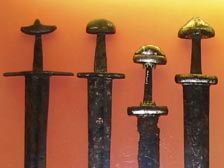
Photo: Viking swords displayed at the Wikingermuseum in Haithabu. Courtesy Viciarg. Used under the Creative Commons Attribution 2.5 Generic Licence.





There all original ulfberht’s, it does not make sense to move the H+T To HT+ or vice versa because why would one miss spell that? The reason I think is because at one point crusiple steel was scarce so he made a cheaper line of ulfberhts, kinda like a cheaper Ferrari compared to the top of the range Ferrari, this makes more sense to me, is there any reason this could be wrong?
I am somewhat dubious about the claims made in popular culture about VLFBERHT swords. It’s worth noting, that the H+T swords as “originals” is just one theory, espoused by Dr. Williams. There is research by others academics which cast this into doubt, such as Dr. Stalsbergs work* which shows that the H+T vlfberhts tend to show up chronologically later that the HT+ vlfberhts. That would seem to indicate the “inferior” HT+ vlfberhts are the originals, and the crucible steel H+T are the copies even if of “better” material.
There are other issues that cause problems for Dr. Williams theory. One is a quote by an 10th C Muslim, Al-Biruni (AD 973-1048), about the brittleness of crucible steel in the Russian winter. This is something that they failed to mention in the NOVA documentary, though it is covered in Dr. Williams article. Crucible steel can be quite brittle if not heat treated properly. As Carbon increases in steel, so too does brittleness. So any gains made by crucible steel by being homogenous can be instantly negated by poor heat treat, and you’d actually end up with a sword MORE likely to break than the supposedly “inferior” bloom steel. Dr. Williams notes that most of the crucible steel swords show no sign of attempts at quenching, which shows they were aware of how difficult it is to heat treat crucible steel by the usual methods.
In the end, I’m not saying Dr. Williams is wrong. I am just saying to treat it as one possible hypothesis.
I tend to agree with your observation. I’ve bought Asian “knock-offs” of famous name clothing that was in fact equal and in some cases superior in materials and workmanship to the originals.
The arrival of crucible steel in Europe and the methods employed by smithies that were “tried and true” based on bloom steel extant at the time would indicate it would take some time to understand the differences in crucible properties and adapt. The customer however can’t wait for one to figure it out. Metallurgical analysis indicating “superior” metal does not necessarily equate to superior craftsmanship.
Best way to think of them in modern terms is knockoff Levi jeans, they still serve/served the purpose they are/were intended to, but trade/traded on the reputation and associated value of the brand name.
Thanks for sharing this.
From the shows I have watched (NOVA: The Ulfberht), the original inlay was spelled +ulfberh+t, the inferior, I wouldn’t say forgery, was spelled +ulfberht+. So, they knew that they knew that materials the smiths had to work with not of the true crucible steel and probably wold have been punished or killed for selling an item that the people of that day relied upon to make a living.
Hello Tom. Interesting observation.
Either way you slice it, so to speak, eventually the perpetrators of this “forgery” would have been found out. What would be the penalty according to the laws of the time?
Hello Mederak. I don’t think early medieval legislation concerning such things is extant.
Were these weapons actually fake, or were they in fact the genuine article but made with the more inferior material for either the reason of lack of good supplies or maybe a cheaper version for the market at the time?
Just a thought.
Hello Rory. The reason behind it is unclear. Theoretically, a fair approach should not let a smith who knew about the inferiority of raw materials put a mark of superior quality on the blade.
So they aren’t fake Viking swords, just not genuine Ulfberhts. Quite probably not claimed to be such by the museums themselves. Good to know. I’ll make a point not to engage anyone in battle with one.
First of all, one should not be referred to a report in the Guardian, on which this post is based, but to the study by Dr. Williams:
Williams, Alan R., ‘Crucible Steel in medieval swords’, Metals and Mines: Studies in Archaeometallurgy (London, 2007), pp. 233-241.
Among other things, the study identifies the use of different raw materials for Ulfberhts during a certain period. Collins English Dictionary defines the verb to fake as follows: to cause (something inferior or not genuine) to appear more valuable, desirable, or real by fraud or pretence. The question is whether fraud or pretence was present in this case.
To be sure, no one blames the museums for any such thing. Notwithstanding the raw materials, high or low carbon content, all the swords of the period, including Ulfberhts, are rare collectibles worthy of being exhibited. However, the fact is that some of the blades that bear the name Ulfberht are inferior as compared to others with the same name.
Blacksmiths who produced inferior Ulfberht blades 1000 years ago seem to have been aware of their inferiority (since they could not ignore the inferiority of the raw materials). When they put the same distinctive mark on swords that were more brittle, they in fact caused them to appear more valuable by pretence. If so, according to Collins definition, they faked Ulfberhts.
I find this all very interesting stuff,but it has really thrown a spanner in the works for me as I have been offered a Ulfberht Viking sword of which I was considering buying until I have started research and reading the Guardians report ,it is going to be a lot of money and money I cannot really waste,but it is a sword with the cross after the T ,so by the report it must mean it is a fake ? Is this sword now worthless and classed as a fake ? and if so what do the museums around the world think of it ? and other viking sword collectors think ?
I would appreciate some proper advice on the subject,
Many Thanks,
Best Wishes,
Chris.
Hello Chris. No, such swords are neither worthless nor classed as a fake. They are valuable collectibles like any other Ulfberhts. They are simply made from raw materials of inferior quality.