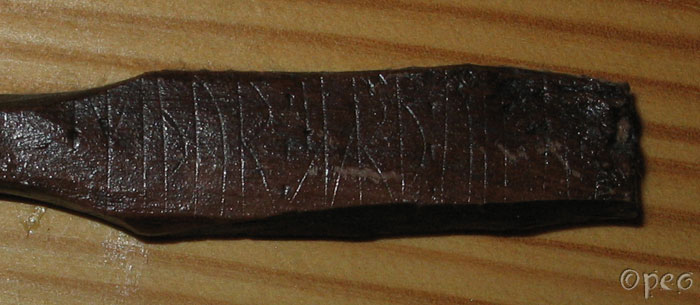
The fire of 1955 destroyed part of Bryggen, the old quarter of Bergen (Norway). This made possible large scale excavations of a medieval town. Archeologists brought to light over 550 objects with runic inscriptions, dating to 1150-1350. The most of them are on wooden sticks with flattened sides. At a time when everyone had a knife, such sticks, called in Icelandic rúnakefli, served as both notebooks and a way to send a letter. Bergen inscriptions revealed much about everyday life in a society, in which runes played a very important role. Below are a few runic inscriptions from Bergen that deal with love. Throughout this post, first goes the Bergen Index number (it is also a link to a picture of the original inscription, if available) with the date, then the runic text, a transcription, the same text in normalized orthography, and an English translation.
B017, after 1248

ost:min:kis:mik
Óst min, kyss mik
‘My love, kiss me’
Above is perhaps the most cute runic inscription I’ve ever seen.
B465, before 1198

mun:þumik:man:(ek)þik:un:þu:mer:an:ekþ(er)
Mun þú mik,
man ek þik.
Unn þú mér,
ann ek þér.
‘Remember me,
I remember you.
Love me,
I love you’.
A naive, but also a very sincere love poem. Next goes a much more down-to-earth saying:
B039, before 1332

smiþur:saarþ:uiktisi af:snæltu:benum
Smiður sarð Vigdisi af Snældubeinum
‘Smidur made love with Vigdis of the Snældubeinar’
Sounds a bit boastful. The following quote is of the same kind:
B390, before 1198

inkebiørkunimerþaerikuarisþafakri
Ingibjörg unni mér þá er ek var í Stafangri
‘Ingibjörg loved me when I was in Stavanger’
The next message was possibly addressed by a worried wife to an errand husband:
B149, after 1248

gya:sæhir:atþu:kakhæim
Gyða segir at þú gakk heim
‘Gyda says that you are to go home’
The following lines are highly dramatic:
B644, before 1198

aneksua:konomansatmer:þykikaltræltr:
enekemuinr:uifsþæsua
Ann ek svá konu mans at mér þykkir kaldr eldr.
En ek emi vinr vifs þessa.
‘I love that man’s wife so much that fire seems cold to me.
And I am that woman’s lover’
The final runic quote here shows that Scandinavians read Virgil. Isn’t it terrific to see his Latin verse written with runes:
B145, ca. 1248

omnia:uinciþ:am(or):æþ:nos:cedamus:amor(i)
Omnia vincit amor, et nos cedamus amori
‘Love conquers all; let us too yield to love.’


{ 27 comments… read them below or add one }
The first 2 quotes are absolutely breathtaking. The first conjures an image of one who leaves a clandestine message for their lover.
The 2nd is more poignant, giving readers a sense of the author’s longing for his love.
For me its proof that love is eternal. Thanks for posting these.
The other side of the wooden stick with the first inscription (B017) has a sequential listing of the Younger Futhark runes. Since such listings were believed to have magical power, this may be a witness of an attempt to charm someone. Or may be the runes were intended to protect the beloved. Breathtaking, anyway.
I always thought it was a love charm too.
thank-you!informative and fun!
The Runes are wonderful. The story is informative and well referenced I wouldn’t be suprised to find out you have a class teaching how to read and write runes.
I am getting married and I liked the rune quote ‘Love conquers all; let us too yield to love.’. How would you say just the first part “Love conquers all”? I would like to get this inscribed on my wedding band and any help would be appreciated.
Hi Jason. It would read:
omnia:uinciþ:am(or):
In the runic inscription it ends with the third instance of :
Does that include the third instance of : in the phrase “love shall conquer all” or is it the first rune of “let us too yield to love”? just want to be really sure before i get the tatt :)
wonderful ancient writing that seems to come to me so easily… thank you so very much.
it seems love was crude and in its infancy! still its entertaining.
Would it be possible for me to use one of these quotes in the back of the book I’m writing on Runes and intuition?
Hi Jennifer. Feel free to do so.
Hjälp
Vad betyder CI IXI IXI S där det första C:et är som ett hörn dvs endast som ett L fast vridet. Andra tecknet är ett I dvs rakt streck och sedan följer det som i något alfabet översätts till “d” (två streck med ett kryss mellan). Sist ett kantigt S.
Nyfiken.
Hi! this website is great! I have a question for you: Where did you find the exact runes of the inscription B465? Reading the runic inscription B465 on the stik of the image, the last three runes don’t seem to me the same you wrote on the website. I tried to find the runes inscription somewhere else, but I couldn’t. It seems you are the sole who have them! :D
Hi, I am planning on getting a tattoo of the “love conquers all” part, but only that line. Where would that end in the phrase that is written?
Hi, Brian. The “love conquers all” is written in runic letters but uses Latin words so I can definitely help you. The first part is what you want and is pronounced like this (this is Latin):
Omnia vincit amor
It seems to me they wrote a symbol like a : to separate words instead of a space and used their rune for þ (usually a th sound) and left off the ‘or’ part of love, so they ‘spelled it’ like this in their runes:
omnia:uinciþ:am(or)
Each letter and colon is being written with a single rune. If you look at the sentence you should able to figure out by counting and noticing the : being used as spaces where the phrase comes to an end.
Hint: You want the runes from the beginning up to and including the second time the rune that looks like a Y with a vertical line through it is written.
Hi! If i were to tattoo the virgil quote just as it is spelled in runes further up,do you know for a fact that that would be completly authentic? Or should i use the converter to get it spelled in younger futhark runes?
Hi Nina. Follow this link for the actual authentic inscription. The quote begins towards the middle of the inscription after three vertical dots.
Hello there! First of all – very helpful sites, thanks for them! Im familiar with elder futhark and i know how to write and read it, but I had a hard time looking on net for informations about how exactly is used younger one. Your converter is nice thing and historical inscriptions with translation are even better. Thanks again. I have a question about word “love” in Old Norse, I hope you can help. I found in english-ON dictionary those words for it: ást (same as in modern icelandic), ástir and elska. No one of them I see here, so Im little confused. If Im not wrong, word unn or unni is used here? Im looking for word describing love between friends, family or man and pet, I dont want to confuse it with sexual love.
Hi Jimmy. Óst is actually a variant of ást.
Yep, I figured it out allready, runes told me, thanks anyway. Unn þú mér,
ann ek þér – i quess unn and ann is word for love used here, ann for first person, unn for second, like in German ich liebe, du liebst, is it like that? Can i use that for dog, friend, family? Dóttir min, ann ek þér, is that ok? My second question is about word Úlfhéðinn in runes – its ON so in Younger Futhark, will it be Úr-Lögr-Fé-Hagall-Óss(???)-Thurs-Íss-Naudhr-Naudhr(twice or not?). I must say I have real problem with this E thing in Younger Futhark.
Hi! I’ve been looking for ideas for runic inscriptions for a wedding ring and yours is by far the most interesting and authentic website I’ve found. I love the rune inscription above: Óst min, kyss mik ‘My love, kiss me’ and was wondering if you know how it would have translated into the Anglo-Saxon fuþorc runes?
just write “ost min, kyss mik” into converter, it should be ok… but AngloSaxon futhorc is better suited for use with Old English, not Old Norse, so maybe translate it into Old English? Only my opinion…
Hi Katy. I agree with JimmyLaser. If you absolutely want to use Anglo-Saxon runes, it would be better to find some quote in the corresponding language.
My wife and I have matching “ost min kis mik” tattoos. i have nothing to add…i guess i am just telling on myself.
I have a ring with the inscription –
mun:þumik:man:(ek)þik:un:þu:mer:an:þyr
so the writing matches the 2nd quote you posted above except for the last 3 characters – I got the ring as a gift from someone who was unsure of its exact meaning and then I found your website. How would you translate given the last word being different? Is it a name?
Thanks
Mun þú mik,
man ek þik.
Unn þú mér,
ann ek þér.
‘Remember me,
I remember you.
Love me,
I love you’.
In the last quote, B-145, Is the “R” at the end a typo? I only ask because all other reseaching Ive done hasn’t shown the runes I’ve seen to have an R shape symbol of such roundness.