Among the most ancient Elder Futhark inscriptions there are a few words that appear pretty often, but what they actually mean is unclear. According to a subtle remark by R. I. Page, in runology, like in too many other knowledge areas, the following principle has been extensively used as a guideline: “Whatever cannot be readily understood must be sorcery.” Indeed, it is quite tempting to declare that runic formulae, which have no clear explanation, were used with magic purposes. However, in this case such attribution is more or less justified. Certain words (called formulaic) do seem to have been used for magic, even though, in the words of J. H. Looijenga,
“Nobody really knows what these words refer to and why they frequently appear on bracteates.”
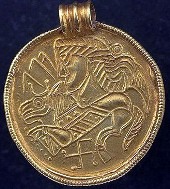
Bracteates are gold single-sided disk-shaped pendants manufactured in the 5th and early 6th centuries in Scandinavia. Their use is also unclear: they may be interpreted as regalia, political or diplomatic gifts. In any case, bracteates reflected high social status of their owners. Researchers agree that they are in fact imitations of imperial medallions of the Constantinian dynasty, which are thought to have often been used as magical amulets. According to A. Andrén, the four formulaic words in runic inscriptions may reflect four words frequently used on Roman medallions: dominus, pius, felix, augustus (‘lord,’ ‘upright,’ ‘fortunate,’ ‘worthy of honor’). The formulaic or magic words in runic inscriptions are as follows: alu, laukaR, auja, laþu, ota.

alu literally means ‘ale,’ but why writing these runes on a stone and bury it in a mound face down? This is what was actually done with the Elgesem rune stone (Norway). It is supposed that alu refers to the state between the world of the living and the dead, some kind of extasy or trance caused by an intoxicating drink. Thus the word might have been connected with death-cult, since the dead were often buried with a drinking vessel in order to enable them to participate in the eternal feast. May be alu replaced or symbolized such a vessel. The word ealuscierwen (Beowulf, line 769) contains the same root. It denotes the state of the warriors who stayed in Heorot while Beowulf fought Grendel, and almost certainly means ‘mortal fear’. E. C. Polomé links runic alu to Hittite *aluwanza-, ‘affected by sorcery’. Below: bracteate Djupbrunns-C, Gotland (Sweden), hoard find. Runes alu run from right to left, swastika.
The other magic word found in runic inscriptions is laukaR:

laukaR means ‘garlic, leek’ and the magical use of these runes might have been connected with the notions of growth, fertility and sexuality. A bracteate with these runes might serve as a magical amulet protecting against evil. Some researchers explain this by the fact that garlic was often used as a medicine or antidote.

The possible meaning of auja is ‘good luck’ or ‘hail’. These runes are interpreted as referreing to ‘fortune,’ ‘wealth’ or ‘possession’. Amulets containing auja might be used for protection. Part of inscription on two identical Raum Køge-C bracteates reads: gibu auja, ‘I give luck’ or ‘I give protection’. Enigmatic gagaga on Kragehul I spear-shaft is sometimes interpreted as meaning gibu auja repeated three times.

laþu means ‘invitation’. These magic runes appear only on bracteates. Their use seems to be connected with the calling of supernatural forces.
Another word that is possibly formulaic is ota:

This word is etymologically related with ON ótti, ‘fear.’ The inscription on the two bracteates found in a grave in Donaueschingen (Schwarzwald, Germany) reads: alu ota.
Copyright notice: photo of Djupbrunns Bracteate used in this article is public domain.





Did you know you could make a world with magic runes??
You can you just need to be advanced in magic
Buried face down so earth energy can flow through it. As such, it is a root (starting place) for the rest of the vortice which the rune sequence shapes. The cup buried alongside it fills up with geo-energy and is distilled by the sequence into that form of energy.
Hi
I was wondering if there was any long branch or alternate younger futhark runes describing beer, alcohol or the production of such. How would this be inscribed?
Cheers Tom
Hi,
This website get in so much details, what tremendous work it must have took. I have a question concerning the name/meaning of the runes. Do runes, in elder or younger futhark, carry a meaning, written on their own? I’m sorry to ask if you did mentioned it on yoor website, I think I went through all of it.
Thank you!
Genevieve
The meaning of alu-ula is indeed fear and also fury … can one think of a singular god..who would fit this description? After all this god is known a a furious wind and howling god… the term is to summon, one single being to their aid in times of emergency,if one is truly worth of his help he will manifest himself to you as dark clouds severe winds and howling the likes of which will destroy any enemy with its blast of fury,but the be extremely cautious, incorectly inscribeing or wearing the bracete without correct runic words one must use supporting runes at beginning and end as so ||| ALU ULA ||| which sheilds the user and is protected by none other than.. “odin” himself..granted it is very ancient and very misunderstood.. i assure you it correct btw if wish to know what rider
represents on the bracate represents baldur and story of his horse rider and subsuquent death.. which is why alu-ula is used… the death baldur odin never got over all that pent up fury.. and what did odin whisper in baldurs ear? .. it was “hope and salvation” odin is saying in cloaked way that after ragnarokk he will resurrect baulder and repeat the cycle of ragnarok again. If my memory severs me correctly we are on our 8th or 9th time.. but do not panic… it it not as bad as it seems.. ive have enjoyed shareing what i know with you.. you are most welcome!
Hi Larry. I agree with you but how did you arrive at these conclusions? You can email me at theartismagistra@gmail.com about your experiences and anything else you were told or discovered in detail and how.