 Mjöllnir or Thor’s hammer is the weapon of the Viking god of thunder. Initially, Thor’s hammer was thought of as made of stone, but in the Eddaic tradition it is an iron weapon forged by Svartálfar (black elves, correlated with the dvergar, dwarves) named Sindri and Brokkr. In the Norse myths Thor’s hammer is often understood as an axe, which, being thrown, comes back like a boomerang. It is also capable of becoming so small as to be carried under the clothes. Mjöllnir is Thor’s characteristic weapon, like Gungnir, Odin’s magical spear, or Týr’s sword.
Thor’s hammer is feared by jötnar, giants of Norse mythology (singular jötunn) who endeavor to steal it or decoy the god of thunder into their lands without his hammer and Megingjörð, Thor’s belt of power. Miniature pendant replicas of Thor’s hammer were very popular in the Viking Age Scandinavia. The variant specific for Iceland was cross-shaped, while Thor’s hammers from Sweden and Norway tended to be arrow or T-shaped. According to some researchers, the swastika shape found in East Anglia and Kent before Christianization, may be a variant of the same symbol. In the original Old Norse manuscripts the name of Thor’s hammer is spelled either mjǫlnir or mjǫllnir. It is thought to be etymologically related to the English word mill and to mean ‘crusher’. Another version states it is related to the Russian word молния and the Welsh mellt, both meaning ‘lightning’.
Many modern Thor’s hammer pendants try to feature the word Mjollnir in the Elder Futhark runes, simply replacing each letter with a corresponding rune. The procedure is incorrect. Mjolnir is an Old Norse word. Old Norse developed in the 8th century. Due to its difference as compared to its earlier form, Proto-Norse, Vikings were to reform their runic writing system. As a result, they adopted the Younger Futhark. By the end of the 8th century the Elder Futhark was not in use any more. If we were to write the name of Thor’s hammer in the Elder Futhark runes, we would have to reconstruct it in Proto-Norse. Indogermanisches Etymologisches Wörterbuch reconstructs it as *melð[u]nii̯az (one should keep in mind that any such reconstruction remains a theory). To my knowledge, there are no runic inscriptions that mention Thor’s hammer (though its image is present on the runestone at Stenkvista in Södermanland, Sweden). However, if a viking would carve the word mjölnir in Younger Futhark runes, he would probably do it like this (it is a mere assumption):

Note that the last rune is ýr not reið. It is because the final -r in mjǫlnir developed from Proto-Germaic -z. The symmetry of this word written in Younger Futhark runes is remarkable.
Thor’s hammer as a Norse symbol widely used by the vikings points to Norse heathen beliefs. It is not a hate symbol. More on Germanic heathen symbols in my earlier article.
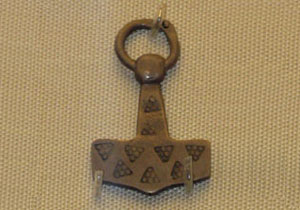
Photo: Thor’s hammer pendant from the collection of the British Museum, dated to the 9th or 10th century, courtesy Thorskegga, all rights reserved. Used by permission.





I had purchased Thor pendants for my children. I have been trying to verify that the runes on it does stand for protection. All I’ve can find is that the Elder Futhark is of religious significance. I’m having trouble translating it, but I have been able to brake down the runes to words. They are Mannaz Wunjo Othala Laguz Laguz Gebo Isa Raido. Can you help me any further with this. Thank you for your time
Sincerely,
Michelle
Michelle-
I don’t know how long ago this was posted but it sounds like these runes are intended to spell ‘Mjollnir’. Perhaps what you are calling Gebo, which looks like a big ‘X’ may be the N-rune Nauthiz which is a line with a small crossbar across the middle at an angle.
None of these runes are interpreted as runes of protection. This concept is usually associated with Thurisaz, Berkano, and Elhaz in the Elder Futhark.
The word mjǫlnir is Old Norse. The idea to write it with the Elder Futhark runes seems strange to me. Elder Futhark was not normally used for the Old Norse language.
Hi there!
Sorry for the bad spelling I´m from Denmark.
I am a jewellry designer and I´m making a pendant for a customer (Thors hammer) with runes on it. The runes have to have a symbolic meaning. The symbols have to stand for Strength Love Family. How can I translate the words so the meaning is correct.
Sincerely Tina Hviid Nielsen
Hello Tina. Runes are basically an alphabet. They normally do not stand for whole concepts.
Not to contradict anyone, but UR is for Strength, WYNN is for Love, and OTHEL is Family. This is what I have read.
I have seen many pendants with only 3 runes carved on them. What are those? First is like a tilted “A” to the left, second like an “F” but upside down and the last one some sort of fork pointing down. Any ideas?
It is probably an attempt to write the word Thor in runes.
Very interesting. I am searching for places that are home to these relics now. I hope to document a map in Europe where they can all be found for people visiting those areas.
Share the map with us if you manage to make it, Christa.
Very nice article and I agree with Dain above that your runic interpretation ended up looking good, as well as being more accurate than the usual ones we see.
Good point about the hammer being made out of metal, not stone. Another detail that artists often forget is that the handle should be shorter than normal since the legends tell us Loki kept interrupting the smith while he was making it and this resulted in the handle not coming out properly.
Loki was always to blame!
And another saga states the handle was broken by the dwarven smiths; sindri & brokkr, whilst arguing…
Why does everyone always try to blame me?
You did sting the dwarf in the eye
Your article about Thor’s Hammer is very interesting. The use of the Hammer may be more than two-fold. It seems that this is a directional type of compass for celestial navigation to ascertain position of the Polar star and constellations that indicated annual seasons and time for harvest of land and sea. The Hammer therefore has survived as a useful tool indeed for these life giving events. The letters that you give for its old name would indicate that it is a compass. The shape of the Hammer informs us with the letter ‘T’, and the pointer is a ‘V’, both shapes are used as a universal celestial measuring device. I think the triangles would be ‘maps’ to align with various stars.
Cheers from Australia.
Hello Christian. Interesting theory.
Thank you for the excellent article.
I was curious if you had Younger Futhark for Odin’s spear Gungnir? Also, was Tyr’s sword named?
Again, thank you.
Hello. The name of the Tyr’s sword is not mentioned in the sources.
Awfully sorry to correct your well-written article on Thor’s Hammer but it’s not a godless symbol, quite the opposite in fact as it celebrates Thor as their God, wouldn’t that make it a Pagan symbol?
If you’re talking about the word “heathen”, it doesn’t mean “atheist.”
I like the bronze looking thor’s hammer in the pic titled Thor’s Hammer – A Norse Viking Symbol – does anyone know where I can purchase it?
Thor’s Hammer
Have you heard about the Corded Ware culture, alternatively characterized as the Battle Axe culture or Single Grave culture of continental northern Europe?
A particular feature was the rounded, or boat-shaped battle-axes found in burials, that to me, are very reminiscent of Thor’s Hammers.
Have a look here: http://en.wikipedia.org/wiki/Corded_Ware
I like your mjölnir in Younger Futhark. It’s very aesthetically pleasing.
Hello Dain. I don’t think there is a connection between Corded Ware culture battle axes and Thor’s hammer.