Younger Futhark Runes And Later Developments

November 29, 2008 · 34 comments


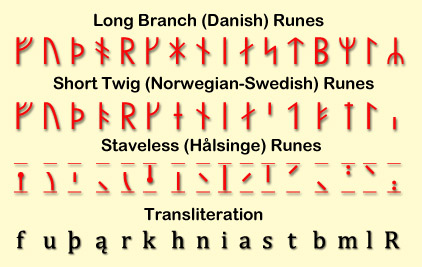
At the end of the 8th century an unknown rune-master reformed the Elder Futhark having reduced it to 16 runes. By the 10th century the new form of writing was accepted in the whole of Scandinavia. This variant of runic alphabet is known as the Younger Futhark. It is this set of runes that may be properly called Viking runes, since they were used by the Scandinavians during the Viking Age:
Younger Futhark runes

The spoken language of that period underwent serious changes. For instance, the number of vowels grew from 5 to 9. If the Agnlo-Saxon Futhorc multiplied the original Common Germanic runes to adapt them for the Old English, the Scandinavian solution was to reduce their number. The most of the runes could now designate a variety of sounds. The earliest Younger Futhark inscriptions were found in Denmark, that’s why they are sometimes called Danish runes (these are ‘normal’ Younger Futhark runes, see the first row above). However, very soon another variant of the Younger Futhark developed. These runes are sometimes called Norwegian-Swedish or Rök runes (see the second row above). Because of the obvious differences between the two, their more common respective names are long-branch and short-twig runes. The trend towards minimalism triumphed in another variant of the Younger Futhark, so called staveless or Hålsinge runes, which were used only in a restricted area (see the third row above).
Normal and short-twig runes were often mixed in inscriptions, which led to appearance of other regional variants. Later inscriptions were carved using so called Medieval runes. Basically, it is the same Younger Futhark with only a few changes, since propagation of the roman alphabet led to the addition of new runes that corresponded to letters, which had no counterparts in the 16-rune system (note that the nasalized /ã/ sound changed into /o/ and the corresponding rune now designated /o/, accordingly). Below, for the sake of convenience, the Medieval runes are arranged in ABC order:

Medieval runes

The rune-names of the Younger Futhark are given below, each with a verse from the Icelandic Rune Poem (15th century) that explains their meanings. The translation is by B. Dickins (published in 1915).

fé, ‘wealth’
source of discord among kinsmen
and fire of the sea
and path of the serpent.

úr, ‘shower’
lamentation of the clouds
and ruin of the hay-harvest
and abomination of the shepherd.

þurs, ‘giant’
torture of women
and cliff-dweller
and husband of a giantess.

óss, ‘god’
aged Gautr
and prince of Ásgarðr
and lord of Vallhalla.

reið, ‘riding’
joy of the horsemen
and speedy journey
and toil of the steed.

kaun, ‘ulcer’
disease fatal to children
and painful spot
and abode of mortification.

hagall, ‘hail’
cold grain
and shower of sleet
and sickness of serpents.

nauð, ‘constraint’
grief of the bond-maid
and state of oppression
and toilsome work.

iss, ‘ice’
bark of rivers
and roof of the wave
and destruction of the doomed.

ár, ‘plenty’
boon to men
and good summer
and thriving crops.

sól, ‘sun’
shield of the clouds
and shining ray
and destroyer of ice.

týr, ‘Týr’
god with one hand
and leavings of the wolf
and prince of temples.

bjarkan, ‘birch’
leafy twig
and little tree
and fresh young shrub.

maðr, ‘man’
delight of man
and augmentation of the earth
and adorner of ships.

lögr, ‘water’
eddying stream
and broad geysir
and land of the fish.

ýr, ‘yew’
bent bow
and brittle iron
and giant of the arrow.


{ 34 comments… read them below or add one }

Julien April 11, 2009 at 12:39 am

Very, very interesting. Thank you so much for your explanation about viking runes. Always wanted to write my name in runes.

Reply

Viking Rune April 11, 2009 at 9:27 am

Thanks for the feedback!

Reply

Oli May 3, 2009 at 12:22 pm

This is so interesting. Your site makes me want to know more and more, excellent work.

Reply

Viking Rune May 3, 2009 at 12:43 pm

Thank you!

Reply

Joe January 5, 2010 at 1:14 am

do you know what the meaning is for ‘oss when its backwards?

Reply

ironore April 7, 2010 at 5:48 am

040610 – Thank you for the information! It took some searching, but these are the runes that most closely resemble those used by DreamWorks in “How To Train Your Dragon” so I am guessing they based theirs on these (at least the one script that appears in the film and the animated shorts, there is another script that incorporates other runes and makes no sense to me as of yet).

Reply

Ingibjörg Ýr April 19, 2010 at 1:10 am

This explanation was not good enough for me. I’m from Iceland and have been learning about the fúþark. But in your explanation I see runes I haven’t seen before or their meanings different. But you might be right nevertheless. Cuz’ i have only been learning about them based on their magical meanings.
Oh, and by the way, the runes name isn’t óss, it’s supposed to be Ás.

Reply

Dewey November 11, 2010 at 4:11 am

oss or As:
the name used depends upon the time period. This is mainly a function of language evolution over years/centuries of use. But the meanings should be essentially similar.

Reply

Eirik May 12, 2011 at 5:04 am

As a runologist and student of runic inscriptions, I can confirm that Ingibjörg Ýr is at least partially right. The Old Norse word for ‘god’ was indeed Ás. The changing of the name to óss was not merely a matter of language changing over time, but is in fact the Anglo-Saxon word for ‘god’. The rune was only called óss by the Anglo-Saxons, who adapted the Elder Futhark to Old English. The Anglo-Saxon runic alphabet is known today as Futhorc.

Reply

Em April 27, 2010 at 3:55 am

OMG! I am doing a school project on the Runes. This is so helpful! Thank you so much.

Reply

MRt May 12, 2010 at 4:26 pm

i noticed you do not have jera?

kind of looks like a close

in fact lots is missing?

is this deliberate?

Reply

Viking Rune May 12, 2010 at 4:41 pm

Hi, MRt. You probably mean the Elder Futhark runes.

Reply

Christy July 29, 2010 at 3:15 am

Hello. I am interested in getting a back tattoo that is in runes. Our family line is linked to “the viking king”. I was curious, exactly what runes would we use? Long-branch or short-twig? The words I would like down my back are: God Jay Zayin Eve Aria. It may seem weird but it is because God is over my family, and then my husband, and then my children. Is there anyway you could send me an image of how it should look?

Thank you for all the information by the way, it’s wonderful to learn about all of this.

Reply

Christian December 13, 2011 at 1:34 am

Out of curiousity what viking king is that? Also if you’re a God fearing person then why are you getting runes? Runes are an ancient Germanic Pagan script and a means of divination. If you’re not a Heathen or at least someone who understands the deeper meaning of runes beyond the superficial/secular “alphabet” then you may want to steer clear of them. These aren’t Scandinavian kanji they’re sigils that will always be indelibly linked to the ancient Germanic pantheon.

Reply

Erik September 14, 2010 at 2:10 am

Hello,
How would I write “norðmaðr”, “fransk”, “norvegr” and “vikingr” in short-twig (norwegian way if possible)? What would be the most appropriate form? In short-twig, there so many ways…

Thanks!

Reply

Antoni Dexter September 27, 2010 at 1:04 am

I want to have my wifes name tattoo’d to my back in runer in old norse. Does anybody know a link to show my tattooist please.

Reply

Jacob Turner November 11, 2010 at 7:19 am

I’m wondering what the most appropriate runic writing would be for my last name if i want it as Norwegian/viking as possible. I want it tattoo-ed! Advice would be appreciated

Reply

Bill December 17, 2010 at 6:01 pm

Hi, I am looking into getting a ring made with my wife’s and my name, Clare and Bill. I am considering both Younger and Elder Futhark. If I go with Younger, I will use the Old Norse forms (which I am learning to read, and which therefore seems more reasonable). My research indicates that in Old Norse, my name should be rendered as Vilhjalmr, but, what would be the appropriate form for the Elder Futhark?

Also, I cannot find a translation of Clare into Icelandic or Old Norse, but it seems to me that Heiðr would be a good ON/Younger F. rendering. Do you agree? If so, what form would be appropriate for Elder Futhark? Is there another form that would be better/truer?

Lastly, if I go with ON/YF, as I expect, I will use ‘ok’ for ‘and’, but would ‘ok’ still be appropriate for Elder Futhark, or would it be something else?

Thanks!

Reply

luke January 4, 2011 at 3:44 am

hi, i’m very interested in writing the swedish word “hälsa” (health in english) in younger futhark runes. I tried to figure it out myself but i cant find the ä sound (ay). Please help me translate!

Reply

Chris January 17, 2011 at 9:01 am

I am of icelandic heritage and I have been researching this for quite sometime and what I want is to know which are the most appropriate symbols and language for the icelandic people(historically). From what I’ve seen so far it’s younger futhark, is that correct and if so what is the most accurate alphabet, as there seems to be many out there? One last question, is any of this linked to any type of magic, curses or nazism?? I have read so many things I’m just not sure what to believe anymore. Thanks

Reply

Viking Rune January 17, 2011 at 10:48 am

Hi Chris. The language spoken in Iceland during the Viking Age was Old Norse. The Younger Futhark was used throughout Scandinavia at that time. Yes, runes were used for magic purposes. As for nazism, see my article Norse Heathen Symbols Are Not Hate Symbols.

Reply

Viktor February 5, 2011 at 1:23 pm

Hi Viking Rune, I would like a little help about a translation. I want to translate this song from the Havamal to younger futhark runes:
Gáttir allar,
áður gangi fram,
um skoðast skyli,
um skyggnast skyli,
því óvíst er að vita,
hvar óvinir
sitja á fleti fyrir.
I want you to tell me would it be wrong if i write it in runes with the upper table or with the rune converter? Thanks

Reply

C. Kennedy February 9, 2011 at 11:26 pm

Hello,

I am looking into getting my last name KENNEDY tattooed on my back and want to make sure I have things correct from this era. Can I just replace each letter with the Younger Futhark version per the rune converter? Do I need to drop one of the double N’s?

I’m half irish / half norwegian….celtic viking!

Thanks for your great work!

Reply

Hallston March 4, 2011 at 9:50 am

What is the etiquette on using oss and ar for letters like a, e ,and o because I noticed that ur can also be used for the letter o.
Also, what would yr be used for, whats its pronunciation?

Reply

JimmyLaser October 7, 2011 at 4:18 am

Million dollar question. Im totally lost in that, same as you.

Reply

Viking Rune January 5, 2012 at 8:30 am

The whole thing is a little bit more complicated than it might seem. First of all, the language of runic inscriptions never had any stable orthography. For example, the word fæðrgaR is a normalized form reconstructed by philologists on the basis of what they found on the actual runestones. I was able to find three instances of that word in the Younger Futhark runic inscriptions: Altune Runestone (U 1161), Vårkumla Runestone (Vg 138) and Bälby Runestone (U 626). Altuna has the actual runic orthography feþrkag, Bälby runecarver shortened the word to a single f rune. Rather late Vårkumla (ca 1200) has faþhar.

Reply

Viking Rune January 5, 2012 at 8:43 am

Runic inscriptions did not have any stable orthography. The use of such or such individual runes varied greatly and depended on individual rune carvers.
The rune ýr stands for R, which evolved from Proto-Germanic [z], it was not the same as r.

Reply

ryan skippy June 5, 2011 at 6:40 pm

hi,
I wonder if you can help me, im getting a norse mythology themed full arm sleeve tattoo , im looking at a prayer to tyr translated into runes but am not sure if i should choose elder or younger?
i dont know if it will help you but in the tattoo there will be the prayer to tyr script, two ravens, a helm of awe and north compass symbol, indervidual runes of odin, tyr and thor and a valkrye.
hope you can help.

Reply

Ryan Akers June 18, 2011 at 8:36 am

Apparently I am of Viking descent. Akers comes from the Norman Conquest, And like most people should be I am very interested in my ancestry an where i truely came from. help me out here I believe i have the physicall genetic ability to truley be of viking descent but i need to be sure. ha

Reply

Chris Yonts July 7, 2011 at 10:42 pm

Tussen takk!

Reply

matt August 5, 2011 at 5:17 am

what rune lettering should i use if i was a decendent of a norwegian viking? should i use younger futhork or short twig, im kind of leaning towards younger futhork because short twig waas brought from sweden or does it really matter what kind of rune lettering should i use because i want to get a tatoo on my forearm that says my name in rune lettering, thanks

Reply

JimmyLaser October 9, 2011 at 8:35 pm

How I will write names of gods in YF? Óðinn like Óss-Thurs-Íss-Naudhr(-Naudhr) but Odin like Úr-Týr-Íss-Naudhr? What about Þórr? Thurs-Óss-Ýr? Thurs-Úr-Ýr? Sorry if im spamming here too much, but I want to learn about YF, how to use it exactly, and i cant find anyone who can/want explain me.

Reply

luke October 24, 2011 at 12:45 pm

thank you so much for that information, you would not believe how long I’ve been on line trying to find exactly this Info. Thanx angain, Luke.

Reply

ERIC January 16, 2012 at 6:01 am

Hello, I was wondering what would be the correct way to write or express “POWER” , “STRENGTH” or the like, in Long-Branch Younger Futhark? Thank you for your time. Also thank you for creating this site, so as to share information.

Reply

Leave a Comment

Previous post:

Next post: