
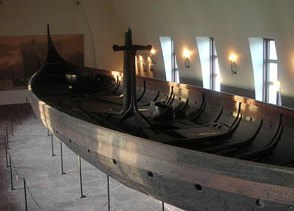
 The Gokstad ship is a Viking ship excavated in 1880 not far from Sandefjord (Vestfold, Norway) by Nicolay Nicolaysen. The ship was buried in a trench. On board, it had a burial chamber of a wealthy chieftain. Above a large mound was raised. Along with the 24 meters long ship, its oars, pulleys, yards and a ladder were discovered, as well as a woolen cloth and ropes that might have been a sail. The Viking grave also included three smaller boats, six beds, a tent, big bronze cauldron, various kitchen utensils as well as a sledge and riding equipment. Among other burial gifts a hunter’s rucksack and a gaming board have to be named, as well as remains of horses, dogs and even a peacock. The Gokstad ship was preserved due to the thick layer of blue clay in which the trench was dug. However, the prow and stern-posts that raised above this layer were completely lost and we have no idea as for how they might originally look. Remnants of 32 shields, painted yellow and black, were found along each board.
Beside the mast and the deck, the Gokstad ship was constructed of oak. According to dendrochronological dating, the timber was felled around 890. Unlike the Oseberg ship, it was very seaworthy. Even though it was believed that Vikings could only sail running before the wind, replicas of the Gokstad ship demonstrated that it could navigate Beam Reach and even Clause Hauled. The anchor was discovered but soon after the excavation the iron disintegrated, with only an oak stock remaining, which is 9 feet length. The anchor of the Ladby ship, which was better preserved, has the same construction. No thwarts for the oarsmen were found, which may indicate that they sat on their sea-chests. Neither weapons nor silver or gold valuables were discovered by archaeologists, which almost certainly means that the Viking burial ship from Gokstad was looted by grave robbers.
The remains from the Gokstad ship were reburied in 1928 but the mound was re-opened in September 2007. The person buried in the Viking ship was suggested to be Olaf Geirstad-Alf, ruler of Vestfold.
Photo: The Gokstad ship. Courtesy rwhgould. Used under the Creative Commons Attribution-Share Alike 2.0 Generic Licence.





Just now seeing your question.
I did get more information about that corn theory which was that the translation of the old language was referring to field crops like wheat but was miss translated to say corn when it was not corn. That was one thing I found to discredit that story.
The story of two large Viking ships that were brought to Nassau Bahamas, I have little to add. The boats were old and I remember smelling rot from the air coming from the bilge. Sorry now I never took pictures which is normally my passion and hobbie.
Not sure both boats sank but I am sure by now if left undersea there would be nothing left by now since it was many years ago, like before 2006 . Have no idea the exact years but they did not last long, maybe operating just one year in tourist buisness.
I do admire the history of Viking ships and did play around making square sail rig on a flat bottom wooden skirt I rebuilt I call the Space Goose.
Just now looking around your sight I thought to comment about a book Men Ships and the sea by National Geographic I got from a friend depicting the shops of the Phoenicians looking very similar in almost all appearance and having the same steering system as well. So much in lost in time since there were no Writen records before writing came to be. Such as who invented what and who copied who or learned from who. We still learning about the past and the movements of people with new tools like DNA, as well as teath telling of people’s diet so we might know where they were from. It as been said the now that the Egyptians were European way back like in the time of the Phoenicians and they sailed to the new world, and brought back cocaine for example found in Egyptian mummies as proof of contact since it only grew in the new world as did corn. Love you sight. Love boats, was brought up one. God Bless !
Just wondered if any one knows about the two viking ships brought to the Bahamas in an attempt to get in the tourist buissness. I walked by the owner but regret not striking up a conversation. The boats were 70 or more feet were old as the smell of rot could be observed down wind. Had diesel engines for power not sure if they used the sailed much. I know one sank at one point in the harbour docked on the Paradise island side. I am told my name Hartley is derived from the mother of Oden and the name is found in Ireland and England where Vikings invaded. Been watching the Viking TV series latley and researching viking history. It spears those same basic peoples invaded the British Isles going back to the ice age. Also I discovered the Celtic people grew corn that originated in Mexico and also discovered the Egyptians had been to mexaco and brought back cocain found in there mummies. Just interesting that the new world was explored even before the viking area. CDH
I did not hear about Viking ships at the Bahamas. Can you tell more about them?
Thank you for that information. I have always believed that those speeds were possible; and with the wind aft, there would have been the fact of planing to a certain degree, until ut became unsafe.
I came to this site to try and find photo’s or pictorial details of the three rowng boats found in the ship. I should like to try and build a replica of one, if I am capable of that.
Thank you,
Louis des Preaux,
“Louisstadir”,
Chez Toru,
17240 PLASSAC,
France.
Let us know if you build one, Louis.
Building a Viking Longship is what we want to do. Should we combine efforts?? Let us know. ‘Jarl’ Torbjorn Lowell Johnsson.
One of my friends locally has with a norwegian competition sailor claimed 20 knots in Oslo Fjord sailing a modern Gokstad replica (Hjemkomsten) He said modern boats often turned to challenge, but were unable to keep up. It must be mentioned that the replica had a keel of composite wood, making it stiffer. It was heavily rigged, but here we have the benefit of doubt. But still very impressive, showing the potential.
Crew of a Roskilde replica where I live claims to have made 17 knots, about 17 meters long, faithful replica. With the right crew and conditions this one could probably break the 20 knot “barrier”.
Very interesting, Erik. Thanks for sharing this with us.