
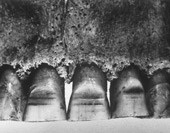
 Caroline Arcini, an anthropologist at the National Heritage Board in Lund, Sweden, analized 557 skeletons from four major Viking burial sites in Sweden. The skeletons date from AD 800 to AD 1050. The results of the study, published in the American Journal of Physical Anthropology in 2006, revealed that 24 of them (10 per cent of men, but none of the women) have horizontal grooves across their upper front teeth.
The grooves were cut deep into the enamel and are often found in pairs or triplets. Dental modification is a practice characteristic for many cultures around the world: during their voyages to Spain and the Mediterranean, Vikings could become aware of such practice after encountering West Africans there. However, African teeth modification was different, with teeth filed into points.
As it seems, the only place where people cut similar horizontal grooves on their teeth at the same period is the area of the Great Lakes and the present states of Illinois, Arizona and Georgia in the United States. It is uncertain whether this fact may be another proof of the Vikings’ contacts with the native population of the North America around AD 1000. The marks on the teeth of Vikings do not seem to be functional, they are rather ornamental. Dr Arcini noted that they are so well made that a person who filed the teeth should have had great skill.
What was the meaning of the grooves that were possibly filled with pigment remains a mystery. They possibly pointed to some kind of achievement or were seen as a mark of social identification. The grooves might have marked those who had them as members of a certain group of warriors or tradesmen, or signified their ability to withstand pain. Future finds may reveal where such a practice arose and how it spread.
Photo by Caroline Alcini.





I can see them sharpening the teeth to a point like k9s but grooves on the sides is not a good idea it could weaken the tooth.
I wonder if Vikings use gold or silver as teeth if they lost one.
Hello Brian. I also wonder if they understood that they actually weakened their teeth. I haven’t heard about gold or silver teeth discovered in Viking graves.