 The results of the study led by Professor Mark Jobling of Leicester University, Professor Stephen Harding and Professor Judith Jesch of Nottingham University, published in Molecular Biology and Evolution in February 2008, show that up to 50% of the blood of men in Wirral in Merseyside and West Lancashire is specifically linked to Scandinavian ancestry. This is about the same as modern Orkney, well known for its Viking links. From generation to generation, DNA of the male Y-chromosome is passed along the paternal ancestry; the team of researchers took advantage of the fact that surnames are also passed along the same lines. The method proved to be especially powerful being applied not to individuals but whole populations.
Thus the group of volunteers had to be selected according to certain areas and specific surnames present in these areas at least prior to 1600. After their expulsion from Dublin in 902 AD, Vikings led by a chieftain named Ingimund landed along the north Wirral coastline between the lighthouse at Lingham (Old Norse lyng holmr), Meols (melr), West Kirby (kirkjubyr) and Thurstaston (Þórsteinns tún). They spread as far as south Chester and Mersey to populate South West Lancashire, where they met another large group of Vikings.
Place names pointing to an area of intense Viking settlement played a major role in the study: for instance, Thingwall is a name of a Viking assembly, and the only two places with such name are in the North West, one in Liverpool and one in Wirral. Other Viking place names include Irby, Skelmersdale, Aighburth, Formby, Crosby, Toxteth and Croxteth. Even Tranmere (and, accordingly, Tranmere Rovers F. C.) is a Viking name: in Old Norse Trani-melr means Heron Sandbank.
Then one had to select 100 volunteers who possessed a surname pointing to Viking links and whose male ancestors lived in the same area for as long as one could trace. To this end, the team of researchers used historical records that included tax lists dating to the time of Henry XIII, as well as a list of inhabitants who had promised to help pay for a priest in Ormskirk in 1366. The surnames included: Taylor, Forshaw, Rigby, Rimmer, Robinson, Oxton, Scarisbrick and Melling.
The gurus on Viking DNA from Leicester University have secured the funding to continue their study and see how far Norse Viking blood runs into Cumbria. More details on Wirral and West Lancashire 1100th Viking Anniversary Home Page by Professor Stephen Harding.
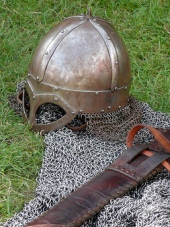
Photo courtesy Steve & Jemma Copley. Used under the Creative Commons Attribution-Share Alike 2.0 Generic Licence.





I am a Bradshaw from the Prestwich line in Lancashire am I norse?
would any one happen to know if, how and when the bradshaw’s or bradshaigh’s tie into the viking/norse lineage or dna? some of what ive found states angelo saxon from north germanic lineage and other info has pointed towards before germania so im not sure which way to go
My Wolstoncrft’s lived in Bolton area as early as mid-1500’s , we also have the clawhand contracture. I believe Sten in Swedish is like croft in English means farm, Have you seen any possible Viking names, such as
Uv which may have been corrupted into a w. ?? Thanks
Maurice,
Sten in Swedish means stone.
Kind regards,
Frank
I am very sorry to see that Professor Stephen Harding believes there was a Henry XIII in Britain. I was not aware of this!
Prof Harding probably meant to write King Henry VIII.
You know, the one with six wives :-)
Have I any viking history I have Scottish grandparent on maternal side and Irish from paternal side and family from Warton
I was wondering if the names Holmes/Bentley/Croad have any connections to the Vikings
Thanks
A Forshaw that can trace her roots back to Tarelton to about 1460’s. Likely family there longer but the church burned in that time frame. Had a DNA test and am 11% Scandanavian…so yup seems like those theories are true.
Had a DNA test recently and it says I have 58 %, 31% Scandinavian, 8% Irish
Sounds cool.
Hi John
I have a great Grandmother from Liverpool, named Julia Melling, her Father was Stephen Melling. I am originally from Liverpool but living in Australia now. By any chance are you related to these two?
Cheers
alex
I Dna tested fairly high levels of Scandinavian, looked into it and found that my Great Grandfather Formby, who’s ancestor is From Formby, lancashire, England is Norse Viking, Cool!!!
I believe my surname is from the Norse king Krok or derivatives.
Could you please confirm or deny this assumption.
I was born in Lancashire as was at least four generations of paternal parentage.
Accrington,Oswaldtwistle,Green Haworth areas
Thank you in advance