
 1. Vikings were a nation. Vikings were not a nation as such, but groups of warriors, explorers and merchants led by a chieftain. As often as not, in the expeditions to the West, Vikings were Norwegians, Danes and Swedes, but also anyone who joined them. The point is that the Old Norse word víkingr denoted not a nationality, but occupation: a Viking was anyone who took part in an overseas expedition.
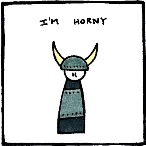
2. Vikings wore horned helmets. Gjermundbu helmet, the only extant authentic Viking helmet, does not have horns. No depiction of Viking helmets dating to the Viking Age represents horned patterns. There are two or three representations of ritual processions where warriors wear helmets with protrusions ending with stylized bird heads or resembling to snakes, but even the ritual use of the horned helmets by Vikings remains unproven.
3. Vikings’ preferred weapon was a massive double axe. Vikings did use axes in battle, as the Lindisfarne tombstone graphically illustrates. However, they were of a very different type than suggested in the modern popular culture. It should be remembered that no double-headed axe has ever been found from early medieval Europe. Viking axes were light and used single-handed. The most common weapons found on Viking sites are spears.
4. Vikings had tresses. As for hairstyle, to proclaim their Viking roots, Norman men shaved the back half of their head entirely, behind a line drawn from over the crown from ear to ear. On the front half of the head, forward of this line, the hair was left to grow long. There is an 11th-century letter in Old English, which mentions “Danish fashion with bared neck and blinded eyes.” There is no historical evidence of Vikings wearing tresses.
5. Viking armies were huge. The sources cite wild numbers for the size of Viking armies. P. Sawyer noted that they could be more specific on the size of the fleets. On the basis of the archeological evidence for the size of the boats, he suggested that Viking ships may have held fifty to sixty men. It means that Viking armies have to be numbered in the hundreds, not even in the thousands.
6. Vikings were exceptionally cruel and bloodthirsty. Vikings indeed were sometimes very violent. However, the question is whether Christian armies of the time acted in any substantially different manner. For instance, Charlemagne, who was Vikings’ contemporary, virtually exterminated the whole people of Avars. At Verden, he ordered the beheading of 4,500 Saxons. Vikings certainly were not as bloodthirsty as many Christians of their time.
7. Abroad, Vikings did nothing except fighting and pillaging. Vikings did pillage many lands. However, plunder was only one among many other goals of their overseas expeditions. Vikings peacefully colonised Iceland, Greenland and many smaller islands. As explorers they crossed the Atlantic and reached America 500 years before Columbus. As international merchants of their time, they also peacefully traded with almost every country of the then known world.
8. Vikings used human skulls as drinking vessels. This misconception goes back to Runer seu Danica literatura antiquissima by Ole Worm, published in 1636 and reprinted in 1651. There the phrase saying that the Danes drink ór bjúgviðum hausa (“from the curved branches of skulls,” that is from horns) was translated into Latin as ex craniis eorum quos ceciderunt (“from the skulls of those whom they had slain”).
9. Vikings were unclean. In England, because of their custom of bathing every Saturday, Vikings had a reputation of excessive cleanness. Ibn Rustah, a 10th century Persian explorer, explicitly notes the eastern Vikings’ cleanness. During excavations of Viking sites, combs are among the most frequent objects found. Vikings used tweezers, razors and special “ear spoons” to keep their ears clean. They also produced soap.
10. Viking ship from Oseberg was a war ship. Oseberg ship is a very well preserved Viking ship found in a burial mound in Norway. In modern popular culture Vikings are often depicted crossing oceans and engaging in battles on ships that are copies of the Oseberg ship. However, her freebord is so low and the scantings so light that she could be nothing more than a ceremonial vessel that never left coastal waters.
Sketch by Repoort. Used under the Creative Commons Attribution 2.0 Generic Licence.





My girlfriend’s mother say’s that real viking men did not have tattoos. My girlfriend’s brother and I have been fighting her about this because she picks and chooses what she like best about her history. So to put this rest please give me an answer
There are real historical records of Norse people and vikings having tattoos, one of them from an Arab traveler named Ahmad Ibn Fadlan (877-960).
“I have never seen bodies as nearly perfect as theirs. As tall as palm trees, fair and reddish, they wear neither tunics nor kaftans. Every man wears a cloak with which he covers half of his body, so that one arm is uncovered. They carry axes, swords and daggers, and always have them to hand. They use Frankish swords with broad, ridged blades.”
At one point, he mentions that all the men were tattooed from the tips of their fingers to their necks. The tattoos were dark green figures of trees and symbols. It is likely, however, that the tattoos were probably dark blue, a color that comes from using wood ash to dye the skin.
Did Vikings keep records of births and deaths?
I don’t think so, Barbara.
Concerning viking armies: Each earl might have had anything from a few ships to tens of ships at his command, so when a king calls to his earls to go to war as an army, the ship count would have been in the hundreds. Each ship carrying those fifty to sixty men and we’re solidly in the thousands. But raising an actual army intent on conquering land was a big deal and would have been a rare occurrence.
The Anglo-Saxon Chronicle talks about the great heathen army and quotes a hundred and fifty ships with Hasten bringing eighty more later. Even with smaller ships that makes a huge army.
Raiding parties would have been only a few or a dozen ships (The chronicle quotes a group of pirates with sixteen ships, the sagas sometimes speak of going raiding with a couple of ships).
Thanks for the comment, Jormundr.
Hey, do you know what would those tattooos looked like?
There is to date NO evidence thatVikings used tattoos in Scandinavia
There are some scant accounts of eastern raiders of
Possibly of Viking descent having tattoos
Thanks for the great article!
You are welcome. Thanks for the feedback.
Vikingir translates from ON as “People of the Bay” as Vik means “bay” and Kingir, “people”.
They were never pirates.
Hello jamie. Another theory states that the words vikingr and viking are from the verb víkja ‘yield’, ‘give way’.
Jamie is right, take it from one who still. ..
The word “viking” wasn’t probably even used during the viking age in the same way as it is now. It was taken into English from Norwegian at a much later stage and it most certainly refers to looters, even in the Norwegian language. In the saga of Harald Finehair, the first king over a united Norway, there is a reference to “vikings who raid all over Vestlandet” (Vestlandet = The Western part of Southern Norway. These vikings were hunted by Harald because of their actions. Harald himself would probably have been insulted to be called a viking.
Hai can you tell me anything about Vikings and tattoo’s?
Hello Jessica. We know that Vikings did have tattoos.
you’re wrong about “no double-headed Viking axes have ever been found “… there was one found on the island of Gotland that has been dated to the Viking era…check your Axe heads on Google or Bing !!! one side was larger than the other, it was not symmetrical but was definitely a double-headed axe !!!
I don’t think that’s true but they did have a Dane axe which was basically an axe that had an extremely long Handel. Also could you put the URL for the image of that axe, I want to see if that is in fact true because I find that fascinating . by the way, you could have by chance seen an image of a short halberd (this was actually a thing back then).