Countless “introductions to runes” each represent the Germanic Elder Futhark in a standardized form, both as for the appearance of the individual runes and the order in which they are arranged (my earlier post on the Elder Futhark is no exception). However, we should be aware of the fact that getting the real picture implies the analysis of actual runic inscriptions, not their standardized reproductions. Let us consider the two earliest sequential listings of the Germanic Elder Futhark runes “as is”:
Kylver Stone:
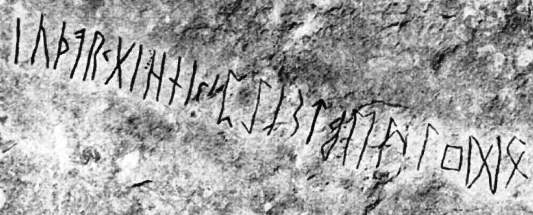
The inscription goes from left to right. Note that f, w and r-runes have no twigs; a, s and b-runes are in a mirror image.
Vadstena Bracteate:
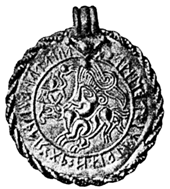
The Futhark inscription begins at 9 and goes to 12 o’clock in the counterclockwise direction (from 12 to 9 o’clock the inscription reads: tuwatuwa). The runes are written from right to left. Note the peculiar form of the p-rune, which looks exactly like b; ï and s-runes are in a mirror image; many runic signs look substantially different as compared to those on the Kylver stone. The last rune is not visible because of the necklace holder, but there is no doubt that it was d-rune (as it appears there on the Mariedamm bracteate, which is almost identical).
Now let us compare the two variants more in detail:
Kylver Stone:

Vadstena Bracteate:

Beside the obvious fact that the inscriptions go in the opposite directions, two more observations should be made: (1) the order of the runes is not the same: groups p-ï and d-o of the Kylver variant go in a reverse order in the Vadstena variant; (2) the Vadstena Futhark is divided into three groups of eight (in Old Norse called ǽttir, ‘families’), beginning with f, h and t-runes. Accordingly, these groups or families of runes were called by the names of Freyr, Hagall and Týr.
Now let us consider the structure of the families on the basis of the rune-order preserved on the Kylver stone (we have to remember that R-rune represents the Common Germanic z):
fuþarkgw-hnijpïzs-tbemlŋdo
A few things are remarkable about these three groups. First of all: each of them contains 2 vowels and 6 consonants. Moreover, the last vowels in each group (a, ï and o) are divided by equal intervals of 9 runes. The number of consonants between the two vowels in each group grows in progression 1-2-4. The number of consonants that go after the last vowel in each group decreases according to the pattern 4-2-0. This is not all: each group has one labial consonant (f, p, b) and a pair of stop consonants, each with an unvoiced and a sonant consonant (k–g; s–z; t–d).
All this shows that the creator of the Elder Futhark had deep insights into the phonological structure of the language for which he designed this form of writing. It is astonishing how elaborate is the inner code of the runic sequence. Whether or not the ancient rune-masters realized the above phonological peculiarities is not clear, but the inscriptions containing the complete Elder Futhark are very numerous. The full set of runes in this order was believed to have supernatural power.
Copyright notice: photos of Kylver Stone and Vadstena Bracteate used in this article are public domain.





Greetings to you all!
While I was looking for more information about the Southwest Script (SW script, AKA tartessian or south lusitanian) I found this wonderfull website and notice some similarities between the signs. Although few of them have the same corresponding latin letter, the most are different. Nevertheless I find this look a like interesting.
The SW script was dated from 2500 years ago and is found in the SW of the Iberian Peninsula (todays south of Portugal and part of Spanish Extremadura). No one was able to translated till yet, although they can find the correspondence to the latin letter for the most part. Furthermore, the reseachers already know that was writen
from right to left and in spriral form.
If you have interesse google for this article:
“Origin and developmentof the Paleohispanic scripts: the orthography and phonology of the Southwestern alphabet.”
Best Regards
Hello Eugénio. Sounds interesting.
Hello, I’ve an artifact an applique made of silver with a stialized Wolf head on one end it’s about 3 inches long and has the runes for IBEKADA set in the silver ( it’s cuttlefish cast) I can’t find out what this could mean, can anybody help?
Thanks
Hello Roland. You may want to post a photo of it on my Facebook page. I’ll try to figure it out.
It is not “MAGIC”…
I suggest you to read the document published on the Internet, “MYSTERY OF THE FUTHARK ALPHABET”, by Turgay Kurum, 1994, Turkey.
It has been claimed there that all of the below are written in “Turkish”:
1. The Kylver stone from Stanga (Gotland) SWEDEN
2. The Mojbro stone from Uppland SWEDEN
3. The Istaby stone from Blekinge SWEDEN
For proof you can just refer to the following authorities:
1. Antropolog Prof. Tord Olsson (Sweden), the Institute for History of Religions
2. Mr. Sonny Berntsson (Sweden), expert on Turkish ethnography
Let me know if you fail in finding the document mentioned above.
Frankly speaking, it does not sound convincing.